29 ARC puzzles opened without reward or training
ARC is a benchmark designed to make memorisation look silly.
Each task gives you a few tiny before-and-after grids. From those examples, you have to infer the rule and apply it to a grid you have never seen. The task is not to recognise a class. The task is to figure out the transformation while the benchmark politely refuses to repeat itself.
The respectable machine-learning story would reach for a training run, a reward signal, or a policy that gradually learns which moves pay off.
We tried something less grand.
No training run. No reward loop. No gradient. The system read the example pairs, searched over a small library of grid operations, wrote a little program, and ran that program on the held-out test.
Intellectually, this is closer to a locksmith than a student: keep the old keys, try them on new doors, and leave metallurgy for a different experiment.
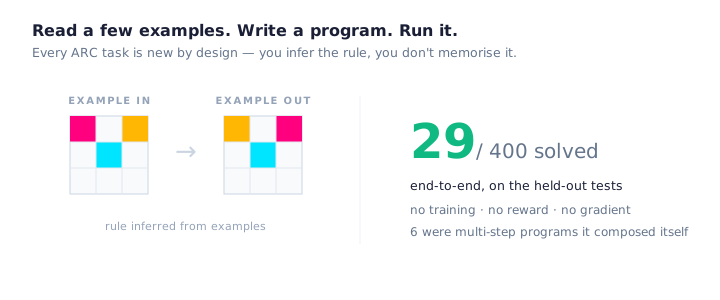
The number
It opened 29 of 400 tasks end to end.
That is 7.3%, which is not a leaderboard result and should not be dressed as one. The useful part is the shape of the win: the system solved those tasks without being paid, punished, or trained into the answer.
Six of the solved tasks were real compositions. The search chained simple operations into multi-step programs we had not spelled out as single recipes: crop-then-tile, and a three-step rotate-mirror-rotate, among others.
All 29 were re-checked against the official held-out tests. They were not training-set impressions. They were small programs that survived contact with the hidden grid.
Where the door stayed shut
The ceiling was also inspectable, which is the underrated luxury of a small mechanism.
The other 371 tasks mostly needed tools we had not given it: counting, topology, object-level operations, and richer ways to talk about parts of a grid. When the missing operation was not on the keyring, the door stayed closed.
That boundary matters. This is not a general ARC solver. It is not evidence that search plus a few primitives magically becomes abstraction.
It is narrower and more awkward than that:
with the right primitive library, some ARC tasks open without reward, training, or a learned policy at all. And when they do not open, the failure is concrete enough to put a name on the missing tool.