Structure from raw numbers: no schema, no training
This was supposed to be the boring sanity check.
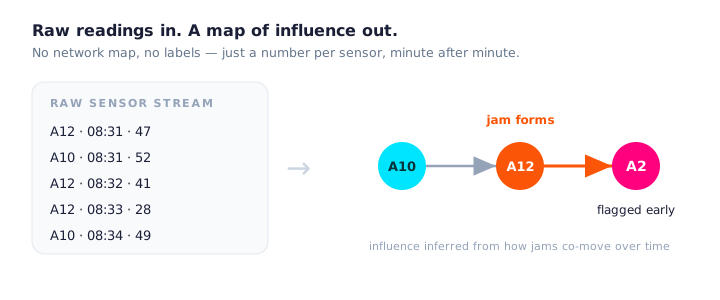
No road map. No labels saying what fed into what. No traffic ontology hiding in the input. Just a sensor id, a minute, and a number, repeated until the stream had enough history to make the setup awkward.
The system did not discover traffic theory. It noticed that jams have habits.
When one road slows, some other roads tend to slow after it. Morning congestion arrives with a rhythm. A downstream sensor can look normal for a few minutes after the upstream pattern has already started misbehaving.
That was enough to recover useful structure:
- Influence. Which roads tend to push congestion into which other roads.
- Warning. Which jams are starting to propagate before the next sensor catches up.
- Rhythm. The repeated daily pattern hiding inside the raw sequence.
The important part is not "traffic is solved." Traffic is the polite version of the problem: clean timestamps, measurable state, visible cascades.
The useful question is smaller and harder to fake: if a stream has real temporal structure, can the system find the interaction pattern before we hand it a schema?
Here, yes. It got road relationships from road numbers because the order of events was already carrying the map. That is more interesting than a universal-data claim, and less embarrassing to say out loud.
Try it yourself below: change road conditions and weather, then watch which cascades the system predicts over the Dutch highway network.